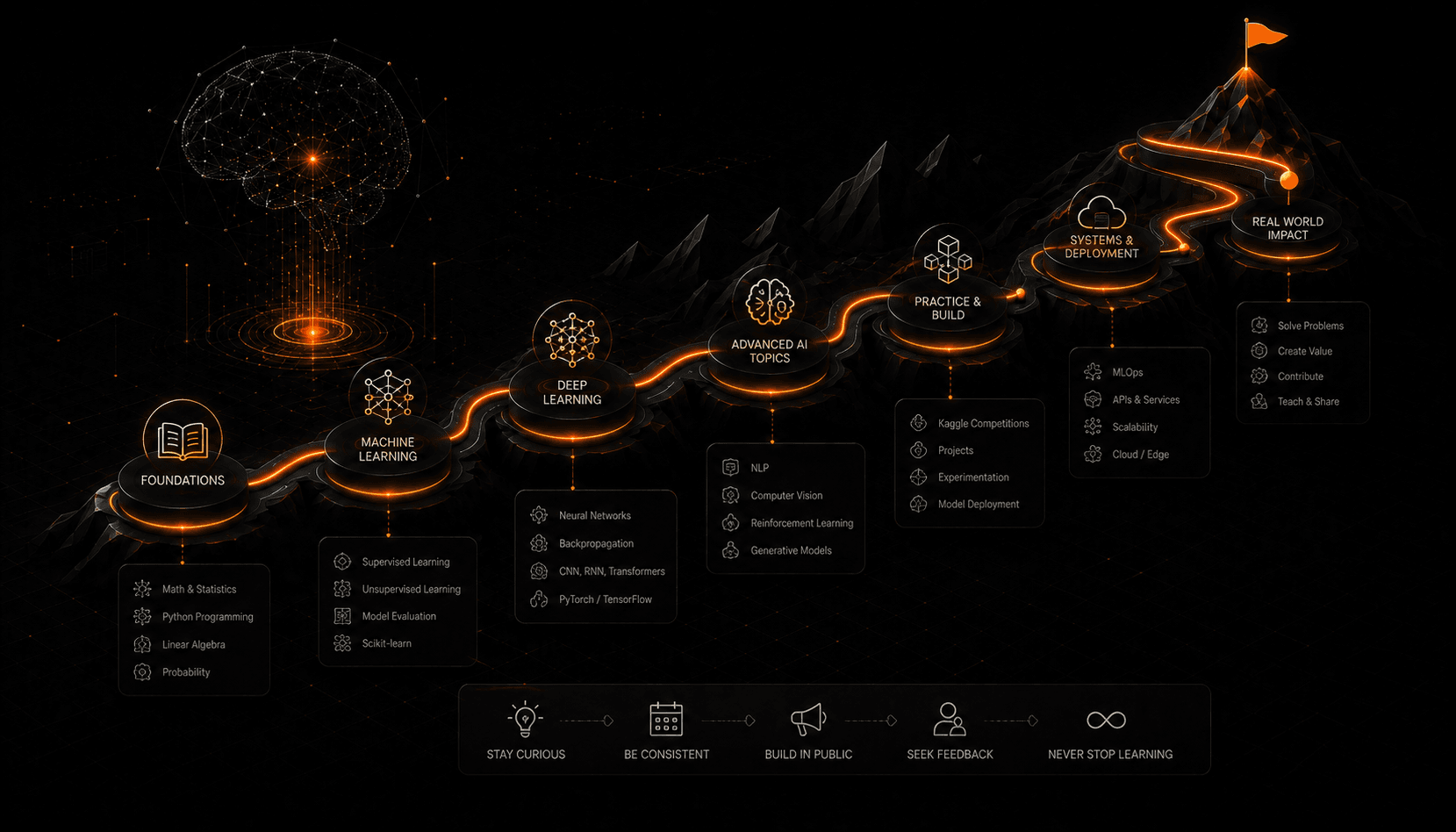
The half-life of a framework is short. The JavaScript library, the cloud service, the hot new language feature — much of it will be replaced or forgotten within a few years, and chasing it is a treadmill. A small set of ideas does not churn like that. Complexity analysis, data structures, recursion, how memory works, how concurrency breaks — these are the same today as they were decades ago, and every hour spent on them keeps paying dividends because everything else is built on top of them. I think of them as the fundamentals that compound: the return is not in this quarter's project but across every project you will ever touch.
Complexity: the language of "does this scale?"
Big-O notation describes how the work an algorithm does grows as its input grows. It ignores constants and hardware to answer one durable question: when the input gets ten times bigger, what happens? That question survives every change in language and machine, which is why it is the first fundamental.
| Growth | Name | Rough intuition |
|---|---|---|
| O(1) | Constant | A hash-map lookup — size does not matter |
| O(log n) | Logarithmic | Binary search — halve the problem each step |
| O(n) | Linear | Scan every element once |
| O(n log n) | Linearithmic | The best general-purpose sorts |
| O(n^2) | Quadratic | Compare every pair — fine small, painful large |
| O(2^n) | Exponential | Brute-forcing combinations — quickly hopeless |
The practical payoff is an instinct: when you write a loop inside a loop over the same large collection, a small voice should say "that is quadratic — will the input ever be big enough for it to hurt?" Often the answer is no and you move on; sometimes it saves you from a system that falls over in production.
Data structures are the vocabulary
If complexity is the grammar, data structures are the words. Each one makes certain operations cheap and others expensive, and picking the right one is frequently the difference between elegant and hopeless.
| Structure | Fast at | Weak at |
|---|---|---|
| Array / list | Indexed access; iterating in order | Inserting or removing in the middle |
| Hash map | Lookup, insert, delete by key | Any notion of order |
| Tree (balanced) | Ordered lookups and range queries | More overhead than a hash map |
| Graph | Modelling relationships and networks | Traversal can be expensive |
A remarkable amount of "make it faster" work is really "use the right data structure". Reaching for a hash map to replace a repeated linear search turns an O(n^2) routine into an O(n) one — no cleverness, just the right vocabulary word.
Recursion and the call stack
Recursion — a function calling itself on a smaller piece of the problem — is the natural way to express anything with a self-similar structure: trees, nested data, divide-and-conquer. To use it well you have to picture the call stack: each call pushes a frame with its own local variables, and frames pop as calls return. That mental image explains two things at once — why a missing base case produces a stack-overflow (frames pile up forever) and why deeply recursive code can exhaust memory where a loop would not.
def factorial(n):
    if n <= 1:          # base case — without it, the stack grows forever
        return 1
    return n * factorial(n - 1)   # each call adds a frame to the stack
Memory: stack versus heap
Under almost every language is a memory model worth understanding even when it is hidden from you. The stack holds function-call frames and local variables; it is fast and automatically reclaimed when a function returns. The heap holds data whose lifetime is not tied to a single call — objects that outlive the function that made them — and it is managed either manually or by a garbage collector.
Why this explains so many bugs
Values versus references, why modifying an object in one place changes it in another, what a null or dangling reference is, why some data must be explicitly freed or will be garbage-collected later — all of it follows from the stack/heap distinction. Learn it once and a whole category of confusing bugs becomes legible.
Concurrency: why shared state is hard
Modern programs do many things at once, and concurrency is where confident engineers get humbled. The root difficulty is shared mutable state: when two threads read and write the same data without coordination, the result depends on timing, producing race conditions that are intermittent and maddening to reproduce. The classic defences — locks, atomic operations, immutable data, message passing — are worth knowing not as library incantations but as answers to the underlying problem. Libraries and languages that "handle concurrency for you" are really just packaging these ideas; understanding the ideas is what lets you tell when the packaging leaks.
Why fundamentals compound
Here is the argument for spending real time on this, even under deadline pressure. Every new framework you will ever learn is an arrangement of these primitives: a database index is a tree or a hash map, a web server's throughput is a concurrency-and-complexity story, a memory leak in a fancy runtime is still the heap. Learn a framework and you can use one tool; learn the fundamental beneath it and you can learn the next ten tools faster, because you already understand what they are doing. That is what compounding means — the fundamentals make everything downstream cheaper to learn.
Practical takeaway
You do not need to memorise proofs or grind competitive programming to get the benefit. Aim for working instincts: notice when a loop is secretly quadratic, reach for the data structure whose fast operation matches your hot path, picture the call stack when recursion misbehaves, keep the stack/heap split in mind when references surprise you, and be suspicious of shared mutable state. Those instincts outlast every framework on your résumé, and they are the cheapest long-term investment in the field.
Sources & Further Reading
- 016.006 Introduction to Algorithms — MIT OpenCourseWareFree lectures and notes on complexity, data structures, and algorithms.
- 02Introduction to Algorithms (CLRS) — Cormen, Leiserson, Rivest & SteinThe standard comprehensive algorithms reference.
- 03Teach Yourself Programming in Ten Years — Peter NorvigA classic essay on why depth and time, not shortcuts, build real skill.
Editorial note — An evergreen explainer of established computer-science fundamentals. Complexity classes and data-structure trade-offs are standard; no benchmarks or product claims are made. The view that fundamentals compound is a stated engineering opinion.